
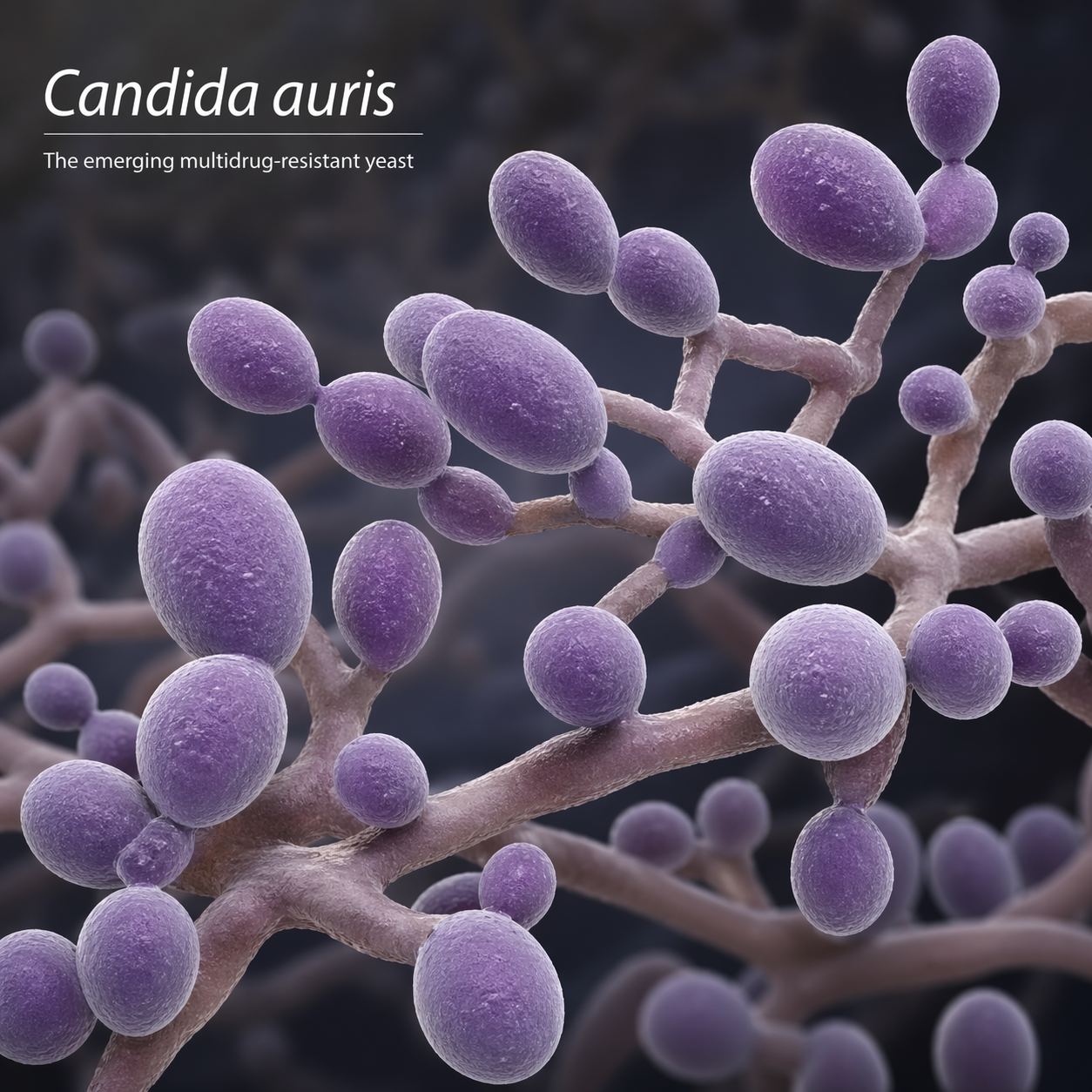
Candida auris – Clinical Overview
Key Insights
Candida auris (C. auris), also known as Candidozyma auris, is a multidrug-resistant yeast associated with invasive and life-threatening infections, particularly in immunocompromised or critically ill patients. It is also notable for its ability to colonize patients without symptoms, with treatment recommended only for confirmed clinical infections. Consultation with an infectious disease specialist is often appropriate.
Overview
- C. auris is a highly transmissible fungus in healthcare settings.
- Patients may be colonized asymptomatically, yet still capable of spreading the organism.
- Clinical symptoms are nonspecific and vary in severity.
- Echinocandins are typically the first-line treatment in adults.
- Accurate identification requires laboratory testing using sequencing or mass spectrometry.
- Early detection, combined with screening and infection control, is critical to limiting spread.
Transmission
- Spread occurs via contact with contaminated surfaces or medical equipment.
- The organism can persist on bedrails, doorknobs, and shared devices.
- Long-term environmental survival makes disinfection challenging.
- Patients may remain colonized for extended periods, even after infection resolves.
- Currently, there are no effective decolonization strategies.
Clinical Features
- Symptoms depend on infection site and severity.
- Can cause invasive infections such as bloodstream or intra-abdominal infections.
- Antifungal therapy is required for clinical cases.
Risk Factors
Higher risk in patients who:
- Require complex medical care
- Use invasive devices (e.g., ventilators, central lines)
- Have prolonged healthcare exposure
Antibiotic & Antifungal Use
- Use of broad-spectrum antibiotics and antifungals is linked to infection and colonization.
- Careful risk-benefit assessment and discontinuation when unnecessary may reduce risk.
Infection Control
- Same precautions apply to both infection and colonization.
- Persistence in patients and environment facilitates spread.
Hand Hygiene
- Low infection risk among providers, but transient contamination is possible.
- Strict adherence to hand hygiene practices is essential.
Environmental Cleaning
- C. auris can survive on surfaces for weeks.
- Requires daily and terminal disinfection of patient areas.
- Shared equipment and rooms must be thoroughly disinfected after use.
Screening
- Strategies vary based on facility exposure and regional spread.
- Patients may carry asymptomatic colonization on skin or body sites.
- Screening via skin swabs helps identify carriers and enforce infection control measures.
Testing
- Samples must be sent for specialized laboratory identification.
- Traditional methods may lead to misidentification.
- Reliable detection requires sequencing or mass spectrometry.
Healthcare Personnel
- Routine testing is not required unless identified as a transmission source.
- Family members do not require testing.
Patient Management
- Echinocandins are recommended for initial treatment in adults.
- Specialist consultation is advised.
Antimicrobial Resistance
- Increasing reports of echinocandin-resistant and pan-resistant strains.
- Evidence suggests transmission of resistant strains, even without prior antifungal exposure.
- Antifungal susceptibility testing is essential to guide therapy.