
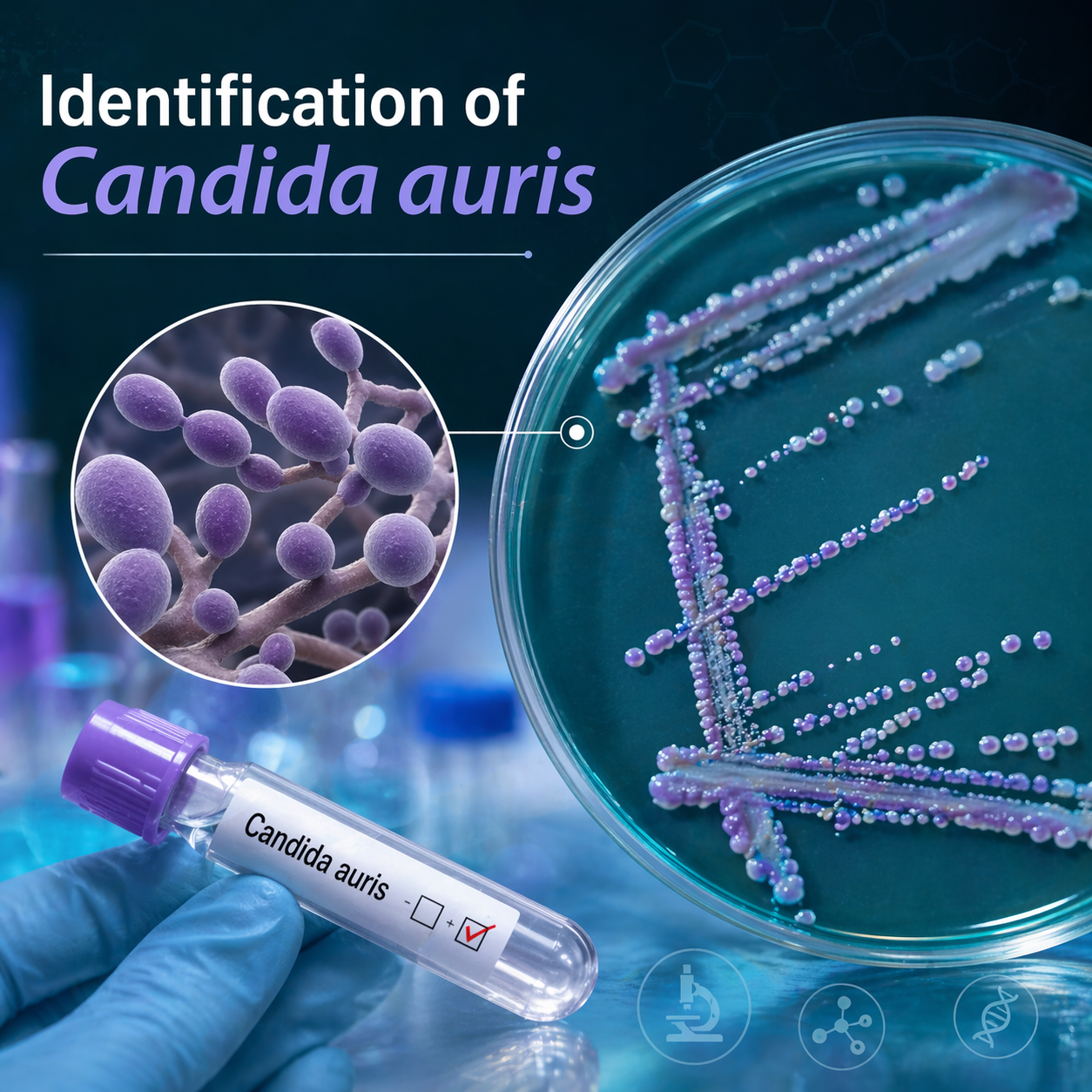
Identification of Candida auris (C. auris)
Key Information
Candida auris is a multidrug-resistant yeast that requires accurate laboratory identification and mandatory public health reporting. Confirmed cases should be reported to local/state health authorities.
Laboratory Appearance & Growth Characteristics
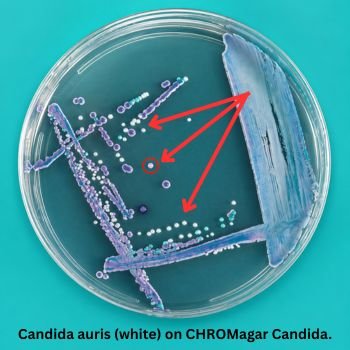
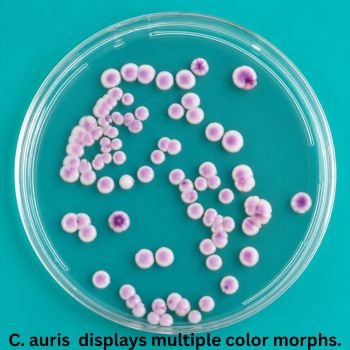
- On CHROMagar, colonies may appear white or pink, sometimes red or purple
- Forms a budding yeast, rarely producing short pseudohyphae
- Does not form germ tubes
- Some strains form cell aggregates, others do not
- Grows well at 40–42°C, unlike most Candida species
When to Suspect C. auris
- Increase in unidentified Candida infections in healthcare units
- Rising isolation of Candida from urine specimens
- Suspected nosocomial transmission patterns
- C. auris can be misidentified as a number of different organisms when using traditional phenotypic methods for yeast identification.:
- VITEK 2 YST
- API 20C
- BD Phoenix
- MicroScan
⚠️ requiring confirmatory testing.
Culture-Based Identification Clues
- Colony color alone is not diagnostic
- Must combine morphology with advanced identification methods
- New chromogenic media may improve detection but are not definitive
MALDI-TOF Identification
Matrix-assisted laser desorption/ionization time-of-flight (MALDI-TOF) systems can identify C. auris if updated databases are used.
Molecular Identification Methods
- Sequencing targets.
- FDA-approved blood culture molecular tests.
PCR-Based Testing
- No FDA-approved high-throughput colonization PCR tests currently exist
- Available PCR methods vary in:
- Sensitivity and specificity
- Turnaround time
- Laboratory capacity requirements
- Validation should consider clinical sample type performance

Limitations of Routine Systems
- Phenotypic systems (e.g., Vitek 2) may miss or misidentify certain C. auris clades
- All isolates in the Candida haemulonii complex should be further evaluated
Referral & Public Health Testing
- Suspected isolates should be sent to:
- State public health central laboratories
- Testing includes:
- Species confirmation
- Antifungal susceptibility testing .
- Sample handling:
- Ship at room temperature
- Use blood or chocolate agar slants
- Specialized mycology media not required
Colonization Testing
- In-house testing is possible with validated methods
- Follow the recommended guidance for:
- Detection of colonization
- Processing of surveillance swabs
Public Health Action
- All confirmed cases require:
- Immediate public health notification
- Coordination with state specific programs
- Potential referral to central laboratories for confirmation