
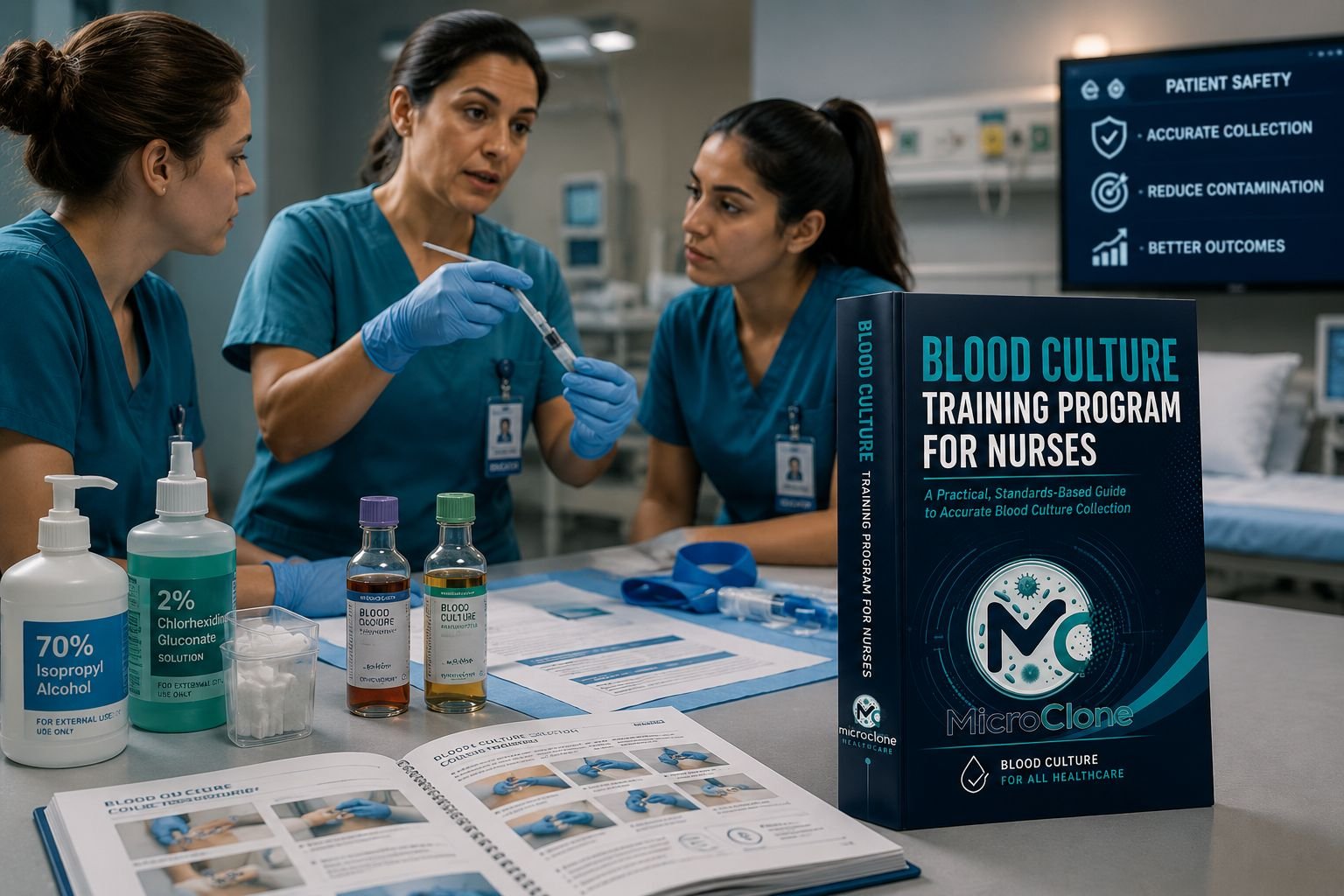
Why Blood Culture Education Matters
In the modern clinical environment, few diagnostic procedures carry as much weight — and as much risk of human error — as blood culture collection. Despite its apparent simplicity at the bedside, the process is governed by a chain of critical decisions and technical steps. For this reason, a dedicated, department-specific training book for nurses is not a luxury; it is a clinical necessity.
1. Ensuring Clinical Accuracy in Diagnostics
A blood culture is not a passive specimen — it is a diagnostic instrument. Its reliability depends entirely on how it is used.
- Standardized Technique: When nurses lack access to a structured reference, technique becomes inconsistent.
- Preventing Contamination: Inconsistent technique leads to contamination, which is a significant diagnostic error.
- The Cost of False Results: A contaminated culture may lead to unnecessary procedures or delay the identification of a true pathogen.
A dedicated training book establishes clinical accuracy as a daily procedural commitment that every nurse applies.
2. Enhancing Multidimensional Patient Safety
The safety implications of blood culture collection extend far beyond avoiding contamination. A comprehensive training resource must address the full scope of patient safety domains:
- Patient Identification: Using two identifiers before collection.
- Pre-procedure Screening: Allergy checks before antiseptic application.
- Technical Precision: Correct site selection and blood volume collection.
- Logistics: Accurate labeling and timely transport to the laboratory.
By aligning nursing practice with frameworks like SBAR (Situation, Background, Assessment, Recommendation), a departmental book ensures no step is treated as optional.
3. Nurses as Frontline Stewards of Antimicrobial Therapy
Antimicrobial stewardship is an institutional responsibility that starts at the bedside. The nurse’s role in collecting cultures is the cornerstone of identifying invasive infections.
“The nurse who prevents contamination through correct technique is performing an act of stewardship as meaningful as any pharmacist-driven protocol.”
When a culture is contaminated (e.g., with Staphylococci), it often leads to empirical vancomycin therapy, causing:
- Increased risk of nephrotoxicity.
- Extended hospital stays.
- Contribution to antimicrobial resistance.
A training book transforms the nurse from a passive executor into an informed participant in the hospital’s stewardship mission.
4. Building and Sustaining Nursing Competency
Training alone does not produce long-term competency. A dedicated training book provides the governance infrastructure needed for:
- Formal Assessment: Written knowledge tests and direct observation checklists.
- OSCEs: Using Objective Structured Clinical Examinations to test clinical judgment.
- Certification: Protocols for initial certification and periodic recertification.
- Quality Outcomes: Linking individual performance to departmental success.
Without a dedicated resource, competency remains informal and unreliable.
Bridging the Gap in Patient Protection
The case for a blood culture training book rests on four interlocking purposes: clinical accuracy, patient safety, antimicrobial stewardship, and sustainable competency.
A nursing department that invests in such a resource builds a culture of clinical accountability. The absence of this manual is not just a gap in training materials — it is a gap in patient protection.